
Trading journals: The missing link in the trading process

7 minute read
|27 Mar 2026
Trader reflecting at desk
Table of contents
  • 1.
    What is a trading journal (and what it isn’t)
  • 2.
    Why trade journaling matters for CFD traders
  • 3.
    The trading journal cycle: a practical approach
  • 4.
    How to structure your trading journal
  • 5.
    Common mistakes to avoid
  • 6.
    Final thought

Most traders think they understand their performance. Few have the data to prove it.

Trading is a fast, repetitive process, with decisions made in real time across hundreds of trades, often under pressure. Over time, memory tends to simplify that complexity, favouring recent outcomes, emotional trades, and convenient narratives.

That can make it difficult to see what is actually driving results.

Journalling introduces a different approach.

It creates a record of decisions, not just outcomes, allowing traders to review their thinking with greater clarity and consistency.

This article explores why journalling matters, and how traders can use it to turn past decisions into actionable insight and more consistent future performance.

What is a trading journal (and what it isn’t)

At its core, a trading journal is a detailed record of your trading activity, including both quantitative data and qualitative insight.

A high-quality journal typically captures three layers:

  • Execution: what you did

  • Context: what the market was doing

  • Decision-making: why you acted

Most traders already have access to execution data through their platform. The edge comes from combining that data with structured thinking.

Because ultimately, performance is not just driven by setups. It is driven by how consistently you execute them.

Why trade journaling matters for CFD traders

1. It exposes the gap between strategy and execution

A strategy may look robust on paper. But that does not guarantee it is followed in practice.

Journaling highlights whether:

  • Entries align with your plan

  • Risk is applied consistently

  • Exits follow predefined rules

In other words, it shows whether you are trading your strategy, or reacting to the market.

2. It turns outcomes into data, not emotion

Without a journal, most traders evaluate performance through recent results.

A winning trade reinforces confidence. A losing trade may trigger doubt.

But outcomes alone are not enough.

A journal allows you to separate:

  • Good trades with poor outcomes

  • Poor trades with good outcomes

That distinction is critical. Over time, this builds a process-first mindset, which is often what differentiates consistent traders from inconsistent ones.

3. It reveals patterns you would otherwise miss

No trader can accurately recall every trade, or the conditions behind them.

Over time, patterns begin to emerge:

  • Certain setups perform better in specific market conditions

  • Performance varies by time of day or session

  • Specific behaviours consistently lead to losses

These insights are difficult to identify without structured tracking.

4. It improves discipline and risk management

Many trading mistakes are behavioural, not analytical.

These include:

  • Overtrading after losses

  • Increasing position size impulsively

  • Exiting trades early or too late

A journal makes these behaviours visible.

Once visible, they can be addressed.

The trading journal cycle: a practical approach

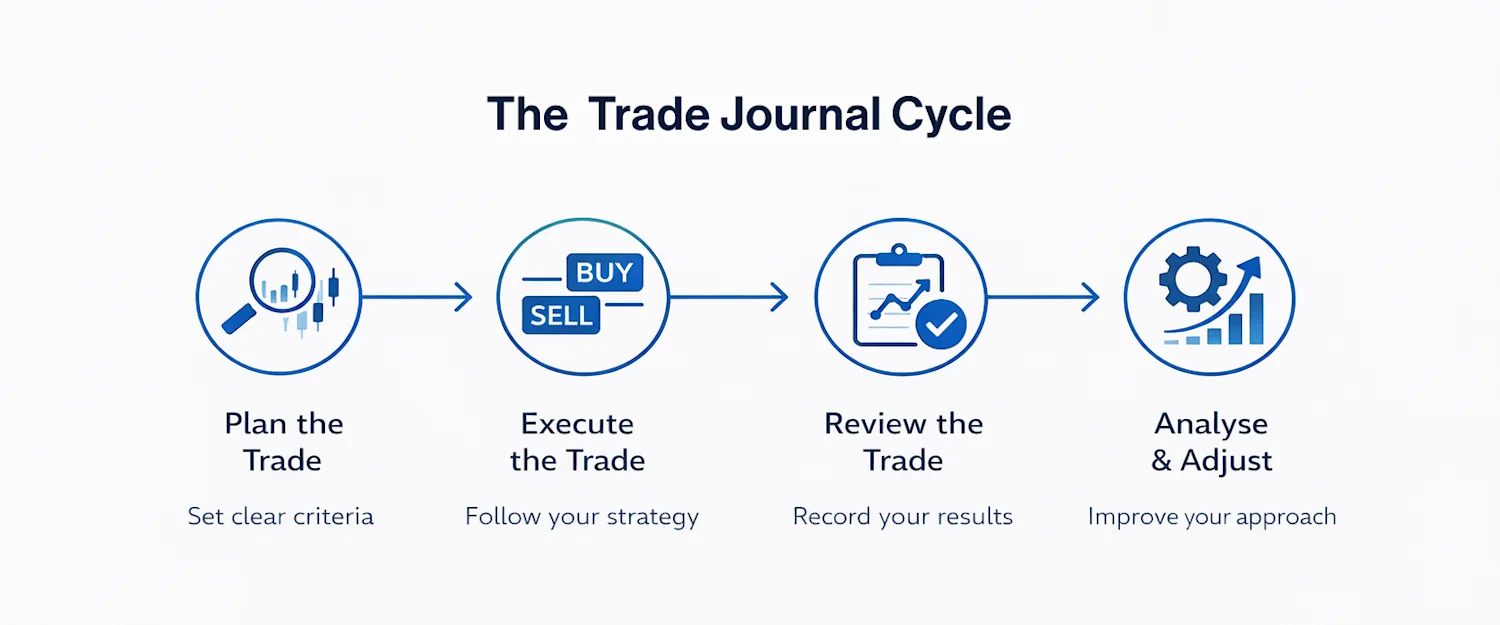
Rather than thinking about journalling as a task, it is more useful to treat it as a cycle.

1. Plan the trade

Every journal entry starts before execution.

This is where intent is defined.

You outline:

  • The setup or strategy

  • Market conditions (trend, volatility, key levels)

  • Entry criteria

  • Risk parameters

Ensure the trade is planned, not reactive.

2. Execute the trade

This is where most traders already focus.

But journalling adds an additional layer.

You track key data points such as:

  • Entry and exit

  • Position size

  • Trade management decisions

  • Any deviation from the original plan

3. Review the trade

This is where journalling begins to create value.

The review should take place after the trade has been closed, once the full outcome and execution can be assessed.

At this stage, you evaluate:

  • Outcome (profit or loss)

  • Risk to reward achieved

  • Whether the plan was followed

  • What worked and what didn’t

Importantly, this is not about judging the result.

It is about evaluating the decision.

By recording both the reasoning behind a trade and its outcome, it allows you to distinguish between decisions that were sound but unsuccessful, and those that were flawed but happened to work. This helps anchor your evaluation in process, rather than results alone.

4. Analyse and adjust

This step sits above individual trades.

It is where patterns emerge over time.

By reviewing multiple entries, you may begin to identify:

  • Which setups perform consistently

  • When performance is strongest or weakest

  • Behavioural patterns that impact results

From here, adjustments can be made:

  • Refine strategy

  • Improve risk management

  • Remove consistently poor behaviours

This is where journalling shifts from record-keeping to performance improvement.

Recording trades is only half the process.

The edge comes from review.

A structured review process may include:

Weekly review

  • Identify recurring mistakes

  • Highlight best-performing setups

  • Assess adherence to strategy

Monthly review

  • Analyse performance by: Strategy, market condition, time of day

  • Evaluate risk consistency

  • Adjust approach where needed

The objective is not to over-optimise. It is to make small, evidence-based adjustments over time.
How to structure your trading journal

A consistent journal should capture both data and context.

At a minimum:

  • Instrument traded

  • Position size and direction

  • Entry and exit timing

  • Strategy or setup

  • Market conditions

  • Trade outcome

  • Brief post-trade reflection

The goal is not to capture everything.

It is to capture what helps you improve.

There is no single “correct” format.

The best structure is the one you will actually use consistently.

Common approaches include:

1. Spreadsheet-based journals

  • Highly customisable

  • Strong for tracking metrics and patterns

  • Could appeal to active traders

2. Dedicated journalling software

  • Combine trade tracking with built-in analytics and tagging

  • Reduce manual setup and streamline review

  • Support more structured analysis across trades and timeframes

3. Platform-integrated analytics

  • Automatically capture trade data

  • Useful for performance tracking

  • Require manual review for qualitative insights

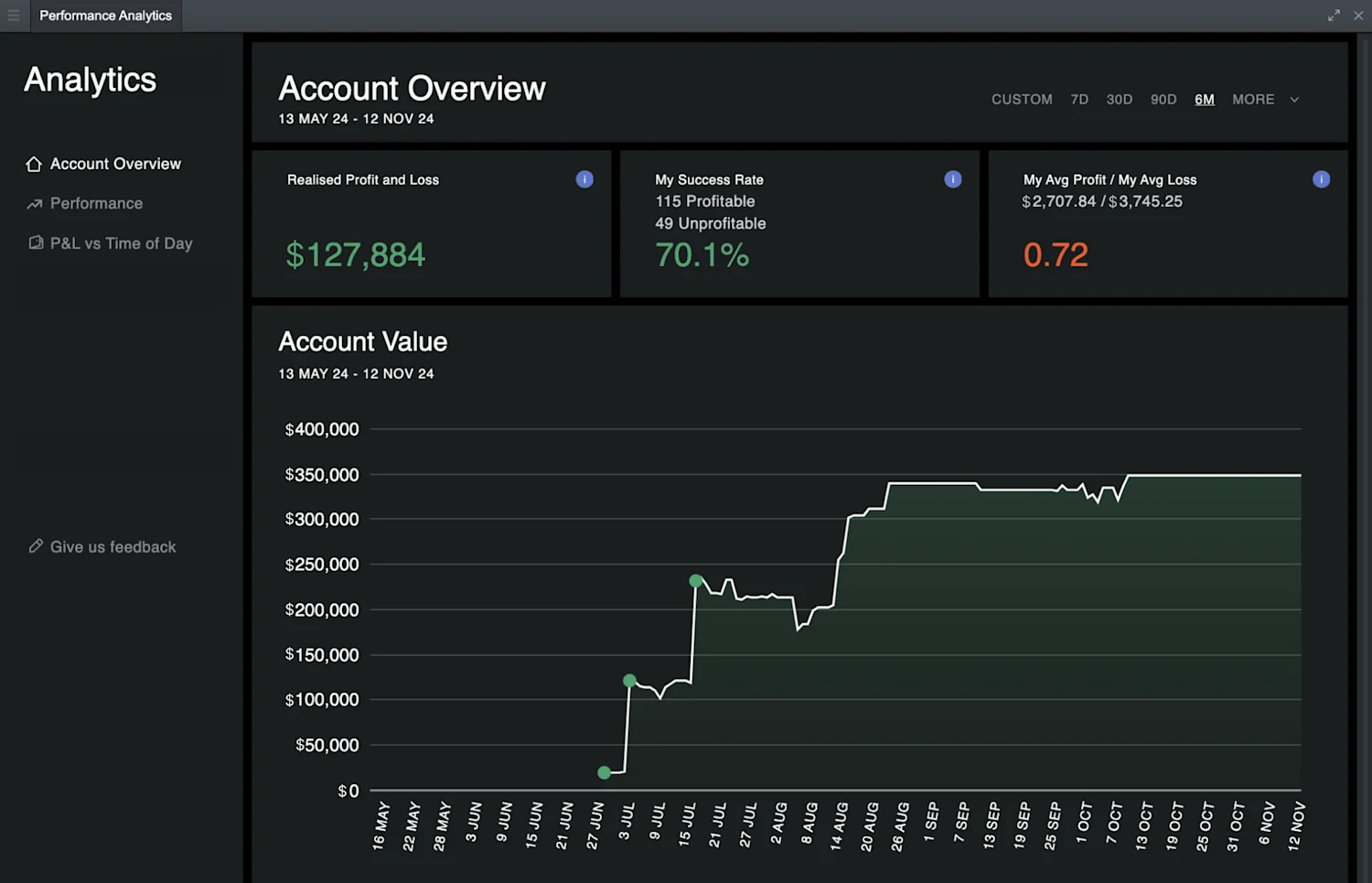
Platform Insight: CMC Markets provides an integrated Performance Analytics tool that allows you to track account performance across key metrics, including realised P&L, total trades, average trade duration, and success rate. This helps build a clearer picture of your trading performance and supports deeper analysis across different timeframes and market conditions. The data can also be easily exported, allowing you to analyse it further or incorporate it into your own journalling workflow.

Common mistakes to avoid

A trading journal may provide structure, but it is not foolproof. Its value depends on how consistently and honestly it is used. To be useful, the data needs to be reviewed with objectivity, humility and a willingness to challenge your own assumptions. Even experienced traders may still fall into common traps:

1. Treating journaling as admin

If it becomes a box-ticking exercise, it loses value.

2. Only tracking outcomes

Profit and loss alone do not explain performance.

3. Ignoring emotional context

Execution is often influenced by mindset.

4. Being inconsistent

Partial data leads to unreliable conclusions.

5. Not reviewing

A journal that is not analysed is just storage.

Final thought

Markets evolve. Conditions change. Strategies adapt.

But one principle tends to remain consistent:

It is difficult to improve what is not measured.

A trading journal does not guarantee better results. But it may offer a clearer view of your own performance, and that clarity is often where more consistent, informed decisions begin.

Disclaimer: This article provides general information only. Past performance is not a reliable indicator of future results. It has been prepared without taking account of your objectives, financial situation or needs. It is not to be construed as a solicitation or an offer to buy or sell any financial instruments, or as a recommendation and/or investment advice. It does not intend to support an investment decision and it should not be relied upon by you in evaluating the merits of investing in any financial instruments.  You should consider your objectives, financial situation and needs before acting on the information in this document. CMC Markets believes that the information in this article is correct, and any opinions and conclusions are reasonably held or made on information available at the time of its compilation, but no representation or warranty is made as to the accuracy, reliability or completeness of any statements made in this document. CMC Markets is under no obligation to, and does not, update or keep current the information contained in this document. Neither CMC Markets nor any of its affiliates or subsidiaries accepts liability for loss or damage arising out of the use of all or any part of this document. Any opinions or conclusions set forth in this article are subject to change without notice and may differ or be contrary to the opinions or conclusions expressed by any other members of CMC Markets. Investing in CMC Markets derivative products carries significant risks and is not suitable for all investors.  You do not own, or have any interest in, the underlying assets. We recommend that you seek independent advice and ensure you fully understand the risks involved before trading. Spreads may widen dependent on liquidity and market volatility. It's important for you to consider the relevant Product Disclosure Statement ('PDS') and any other relevant CMC Markets documents before you decide whether or not to acquire any of the financial products. Please visit our site to view the PDS, applicable Terms and Conditions of Trading, and our Other Material Information document. CMC Markets NZ Limited (registration number 1705324) is registered on the Financial Service Providers Register (FSP41187).       

Join an award winning CFD provider
Practise CFD trading with $10,000 of virtual funds on a risk-free demo account.
Access 12,000+ instruments on our award-winning CMC Markets Platform. Including indices, forex and shares.
Enhance your CFD trading on MetaTrader4 with CMC Markets and access 175+ forex pairs.
Tight spreads and low margin rates.