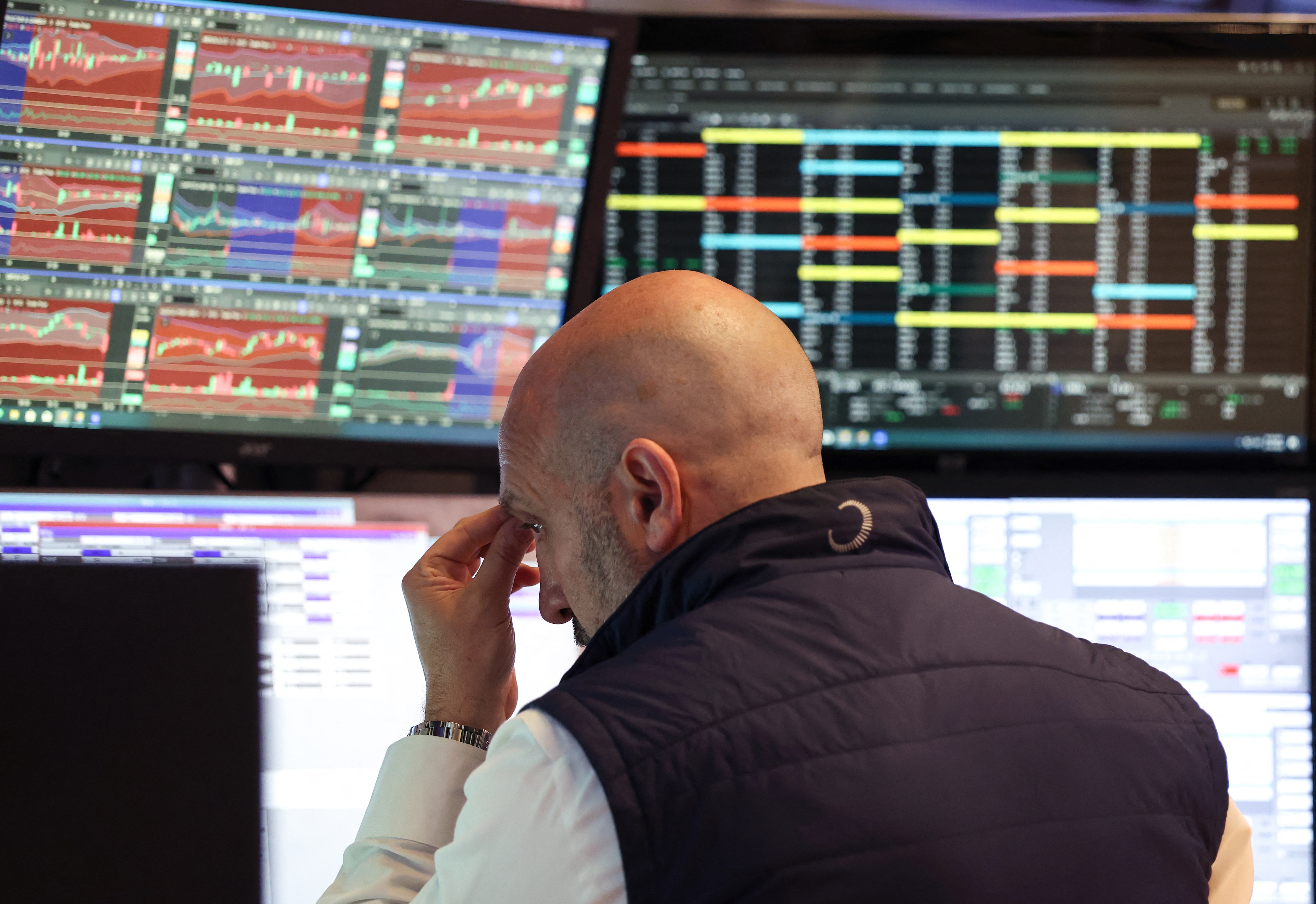
Semiconductor stocks near bear market as AI rally cools
Semiconductor stocks are close to bear-market territory after the PHLX Semiconductor Index fell nearly 20% from its record high, forcing investors to reassess AI spending, valuations and the sector's cyclical risks.

CMC Markets Poland
Semiconductors approach bear-market territory
The semiconductor sector, which for many months was the undisputed leader of Wall Street's gains and the main engine of the artificial-intelligence rally, is now on the edge of a bear market.
The PHLX Semiconductor Index, which tracks 30 major chip and component makers, has suffered a painful decline of almost 20% from its record high. The sell-off has cooled investor sentiment sharply and forced the market to ask a fundamental question: has the excitement around the semiconductor trade already faded?
AI expectations meet a higher bar
The sharp retreat in capital has coincided with record financial results from Taiwan Semiconductor Manufacturing Co. Although TSMC lifted its revenue outlook and announced record capital expenditure, expectations across the technology sector had already been stretched to the limit. That turned otherwise strong news into a trigger for profit-taking.
Analysts point to a combination of risks beyond valuations alone. Investors are increasingly questioning whether the current pace of spending on AI infrastructure can be sustained over the long term, especially while the commercial returns from the technology remain hard to quantify.
Competition and geopolitics add pressure
Reports of a technological breakthrough by Chinese AI startup Moonshot have added to concerns about global competition and the potential risk of oversupply in chips. At the same time, geopolitical tensions and the threat of new trade restrictions have encouraged institutional investors to rotate out of richly valued technology names and into more defensive or cyclical sectors.
The fundamentals of many chipmakers remain strong, but the market is sending a clear signal that the period of blind optimism has ended. The sector may now be returning to the type of cyclicality that has historically defined the semiconductor industry.
The market wants proof of returns
The current shock in semiconductors fits the pattern often seen during major technology revolutions. The market has reached a phase in which promises about AI's long-term power are no longer enough.
Wall Street is now asking harder questions about return on investment. Funds want to see real dollars earned from AI software, not only the multibillion-dollar infrastructure bills being paid to companies such as Nvidia and TSMC.
Source: CMC Markets, as at 20 July 2026. The source chart is carried through from the Polish article.
TSMC shows the asymmetry in expectations
The TSMC reaction highlights the paradox facing the sector. The company published an excellent financial report and raised its guidance for the rest of the year, yet its shares still fell for several sessions.
That is a classic example of asymmetric expectations. When the market prices companies for perfection, even strong results may fail to surprise investors positively. Instead, they can become a reason to lock in profits and raise cash. News around Moonshot also undermined the earlier narrative that the West had a secure monopoly on innovation in AI.
Europe and Wall Street end weaker
European equity markets have been searching for direction for some time. Friday's session across the main European exchanges ended with a clear advantage for sellers. Apart from the FTSE 100, which gained 0.27%, major indices fell between 0.34% for the DAX and 0.94% for the FTSE MIB.
Wall Street also saw weaker sentiment, mainly because of the sell-off in AI-related shares. The Dow Jones lost 0.77%, the S&P 500 fell 1.01%, and the technology-heavy Nasdaq declined 1.4%.
Asian markets remain mixed
Asian markets have shown mixed sentiment for the past three weeks, and the new week has begun in a similar mood. There are signs of an attempted rebound after Friday's sell-off, although Japan's market is closed for a holiday.
Australia's S&P/ASX 200 is up 0.2%, while South Korea's KOSPI is down 3%. Elsewhere in the region, Hong Kong is up 2.08%, Shanghai has gained 1.18%, India's Sensex is down 0.6%, and Singapore is up 0.06%.
Warsaw pulls back after recent highs
A pullback on the Warsaw Stock Exchange was not surprising after the WIG and WIG20 climbed to new highs last week. Optimism remains visible on the local market, and the June decline in the WIG20 was halted near local support around 3,553 points before a solid demand response emerged.
For now, there is still little sign of fear in Warsaw. The uncertainty is more visible in European indices, the S&P 500 and the Nasdaq 100. The global risk-asset backdrop remains dynamic and tense, with US liquidity and bond yields still important variables for investor sentiment.
Turnover across the broad market reached PLN3.15bn. The WIG fell 0.78%, blue chips lost 0.77%, and WIG20 futures declined 0.85%. Mid- and small-cap stocks also weakened, with the mWIG40 down 0.87% and the sWIG80 ending 0.47% lower.
The zloty remains under pressure
GBP/PLN is currently trading at 5.10.
EUR/PLN is quoted at 4.33 today.
USD/PLN is trading at 3.78.
CHF/PLN is currently at 4.69.
PLN/JPY is trading at 42.84.