Arbitrage trading: What is it and how it can improve your strategy

10 minute read
|6 Jul 2025
Arbitrage visualised
Table of contents
  • 1.
    What is arbitrage trading?
  • 2.
    How does arbitrage trading work?
  • 3.
    Key arbitrage trading strategies
  • 4.
    How to apply arbitrage to your trading strategy
  • 5.
    Get started on our arbitrage trading platform

Arbitrage in trading is the act of exploiting pricing differences or inefficiencies within the financial markets, such as forex, commodities and shares, with the aim of making a profit.

Arbitrage is a useful process for traders, because being able to profit from a mispricing can help to drive the asset’s price and overall market back to equilibrium. It is a short-term trading strategy​ that can provide low-risk investment; however, as with all strategies, there are always some risks to consider.

What is arbitrage trading?

Arbitrage involves profiting from the price difference between identical or related financial instruments​, though this usually doesn’t involve large percentage profits. The bigger the mispricing of market inefficiency, the bigger the profit, and the quicker traders will jump in to exploit it. This will reduce the profit potential and bring the asset back into alignment with other market prices or information.

An arbitrage opportunity often becomes apparent through comparing assets. If two currency pairs​ often move in the same fashion, but then start to diverge, this may present arbitrage in forex trading, under the assumption the two pairs will eventually start moving together again. If two very similar assets are priced differently without justification, this may also present an arbitrage opportunity.

This means that large inefficiencies or mispricing won’t last long, but small inefficiencies may last a long time, since there is less incentive to capitalise on them.

Arbitrage pricing theory

Arbitrage pricing theory assumes that asset returns can be predicted based on its expected return, as well as accounting for macroeconomic factors that affect the price of the asset. In trading, if this is true, an inefficiency can be identified and a trader could potentially profit from the difference between the “incorrect” price and the theoretical fair price.

Often, arbitrage is referred to as a “risk-free profit”, although, in reality, very few trades carry no risk. Therefore, an arbitrage method may provide a trading edge for winning, but if the arbitrage is based on assumptions and those assumptions are wrong, the trade could result in a loss. Arbitrage pricing theory is built on assumptions, which include the expected return of the asset, that interest rates won’t change, and that we can identify all variables that affect the price of the asset. This isn’t feasible with a high degree of accuracy, but it may still alert a trader of a potential opportunity.

Arbitrage pricing theory attempts to isolate where there is a potential profit, also assuming that the price will revert to its historical tendencies. Things that are mispriced tend to revert to more realistic pricing over time. Therefore, whether the theory is used or not, the concept is important for capitalising on these types of trading opportunities.

How does arbitrage trading work?

Arbitrage works by taking advantage of the financial markets​ and the fundamental factors that drive a security’s price, such as supply and demand. This is done in multiple ways. There is statistical arbitrage, which equates to mean reversion​, as well as triangular arbitrage for currency markets. Some more narrow strategies for arbitrage trading include risk arbitrage, fixed-income arbitrage and covered interest arbitrage, all of which will be discussed below. Arbitrage strategies are similar to high-frequency trading strategies​, which are often used by institutional investors.

In all cases, a trader uses evidence and research to uncover a profit potential due to the mispricing of one or multiple assets.

Statistical arbitrage

Statistical arbitrage is the process of analysing statistics of how assets typically perform and then noting deviations. A high positive correlation between assets is a statistic that is commonly used, which is often found in another short-term trading strategy, pairs trading​.

Using the share market as an example, if Ford and General Motors prices typically move together, but then suddenly move away from each other, this may be a temporarily exploitable opportunity. If they typically move together, there is reason to believe they will again in the future. This is based on a mean reversion model.

Using statistical arbitrage, a trader could short the stock​ moving up and buy the one moving down. They should be moving in opposite directions, otherwise they are still correlated. In this way, the trader is not betting on the overall direction of both stocks, but rather the profits if the prices do converge again.

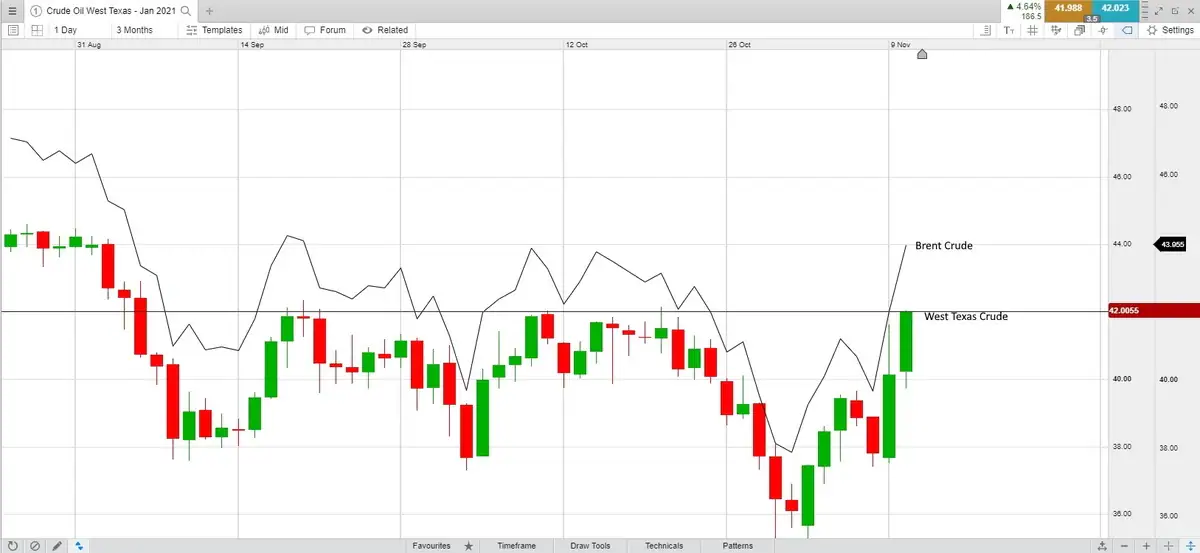
Popular commodity products West Texas Crude and Brent Crude typically move together also. They are priced differently, so if the typical spread between them narrows or expands, this may present a statistical arbitrage opportunity. This is demonstrated in the chart below.

Arbitrage-trading-1 extra

Triangular arbitrage

Triangular arbitrage is often used for the forex market​, when there is a pricing discrepancy between three related currency exchange rates. Triangular arbitrage involves three transactions: exchanging the initial for the first currency, exchange the first currency for a second, then converting the second back to the initial. If these transactions create a profit opportunity, there is arbitrage.

The profit potential is usually small, although, in moments of high volatility or currencies that are not traded as often, the potential for profit may be greater.

For example, if the bid in the EUR/USD is 1.0847 and the GBP/USD bid is 1.4808, this would imply a EUR/GBP bid rate of 0.7325. If the price is different, especially by more than a couple of pips, then there is opportunity for profit.

Retail arbitrage

Retail arbitrage happens more outside of the financial markets. Being able to buy a widget at Walmart for $5, then sell it on Amazon or eBay for $6 is retail arbitrage, exploiting a mismatch in different markets.

Let’s put arbitrage into a real world context. Imagine that all houses on one street offer the same features and are priced roughly the same, but one house is being sold for far less. The house won’t last long, as maybe a homeowner will buy it, removing the mispriced asset. However, someone may buy the property at the lower price in order to re-sell at the same price of the other houses on the market in an attempt to net a profit. This is known as retail arbitrage, and it can be done in many ways and in various markets.

Key arbitrage trading strategies

Risk arbitrage strategy

Risk arbitrage is a speculative and event-driven trading strategy​, also known as merger arbitrage. It attempts to make a profit from opening long positions in stocks that are targeted by mergers and acquisitions.

A common example is when one company buys another that is listed on a stock exchange. Let’s say that Company A agrees to buy Company B for $10 a share. Typically, until the deal is closed, the stock will trade at $9.75 on the stock exchange, not $10. It won’t trade at $10 as there is a chance that the deal won’t go through.

The $0.25 represents a risk arbitrage opportunity. A trader could buy the stock at $9.75 knowing that if the deal completes, they will gain $0.25 per share purchased. This is the expected return risk premium, or the compensation for taking on the risk.

The risk is that the deal may not go through, in which case Company B’s share price falls back to where it was prior to the buy-out announcement. Some of the risk could be offset by taking a hedge. A hedging strategy could be to short the acquiring company (Company A) or buy a put option on Company B, assuming that the premium doesn’t offset the entire potential gain.

Fixed income arbitrage

Fixed income arbitrage is a strategy that can be used by traders for fixed income securities, such as stocks and bond trading​​, with the aim of profiting from the difference in interest rates. Institutional traders can also employ this method in more complex interest rate products.

As an example, let’s say that two cities offer municipal bonds. The cities have very similar economies, debt loads, revenue, expenses, and unemployment rates. One bond has a yield of 3%, while the other has a yield of 2.85%. A trader believes that the two bonds should yield the same. Therefore, they short the 3% bond and buy the 2.85% yielding bond. If they are correct and the bond yields eventually align, whether rising, falling, or meeting in the middle, the trader will profit from the 0.15%.

The same concept could apply to companies that issue bonds. If the companies are similar, but the bonds offer different interest rate yields, there may be an arbitrage opportunity. A trader could short the “overpriced” yield and buy the “under-priced” financial asset.

The risk is that the yields do not converge or the spread gets even wider. In the latter case, the trader will start to lose money.

Covered interest arbitrage

Covered interest arbitrage exploits the differences of interest rates of foreign currencies between countries. This is carried out through futures or forward contracts​ in order to reduce exchange rate risk.

The forward market accounts for interest rate differences between currencies. If the forward market doesn’t accurately factor the difference in interest rates, then a trader could profit at the expiration of the forward contract.

Covered interest arbitrage involves a number of steps in order to profit. Uncovered interest arbitrage is less complex but comes with more risk. With an uncovered strategy, there is no forward contract, so a trader is simply borrowing in a lower rate currency and investing in a higher rate currency. This works if the higher interest rate currency doesn’t drop more than the interest rate differential. If it does, the practice loses money because, when funds are converted back, they will be less than the original loan amount.

Arbitrage calculator

An arbitrage calculator, or arb calculator for short, calculates what the theoretical price of an asset should be based on other inputs and how much you should stake on a trade to guarantee profit.

For example, a triangular arbitrage calculator requires the prices from two currency pairs to calculate the fair price of the third. If the real market price is different, the trader can decide if this is a tradable arbitrage opportunity.

While an arbitrage calculator likely has some sophisticated programming behind it, traders are cautioned to understand the math behind the calculation. For example, if the calculator is rounding, this could eliminate or increase the amount of arbitrage. Therefore, consider double-checking the math before relying on third-party calculations.

How to apply arbitrage to your trading strategy

  • Compare the asset’s market price to the projected or historical price/tendency, or possibly to other comparable assets.

  • Calculate the potential profit from the arbitrage trade.

  • Deduct fees and transaction costs. Consider spreads, commissions, and interest costs.

  • Consider the risks and employ a suitable risk management strategy to help your trade.

  • Double check the maths and plan how the trades will be executed. Write it down, then ideally have all the orders ready to execute at the same time, if possible.

Get started on our arbitrage trading platform

Using our online trading platform​​, Next Generation​, you can make use of simple arbitrage strategies, such as pairs trading, asset correlations for hedging and forward contracts, which are available across multiple markets and instruments. A particularly popular form of arbitrage trading is scalping​, which is commonly practised on our platforms by both retail and institutional traders. Learn more about the best tips and strategies on how to scalp forex​.

Explore automated arbitrage trading

You can also try out automated arbitrage strategies using our international hosted platform, MetaTrader 4 (MT4), which provides the potential for algorithmic trading through the use of Expert Advisors (EAs). These programs can be created or downloaded by the platform to search for arbitrage opportunities.

When using an automated program to trade, it is important to monitor its performance and understand how it functions. Such programs could include coding or mathematical errors that could result in losing money. It is important that a trader do their own due diligence before deploying any automated trading programs.

Disclaimer: This article provides general information only. It has been prepared without taking account of your objectives, financial situation or needs. It is not to be construed as a solicitation or an offer to buy or sell any financial instruments, or as a recommendation and/or investment advice. It does not intend to support an investment decision and it should not be relied upon by you in evaluating the merits of investing in any financial instruments. You should consider your objectives, financial situation and needs before acting on the information in this article. CMC Markets believes that the information in this article is correct, and any opinions and conclusions are reasonably held or made on information available at the time of its compilation, but no representation or warranty is made as to the accuracy, reliability or completeness of any statements made in this article. CMC Markets is under no obligation to, and does not, update or keep current the information contained in this article. Neither CMC Markets nor any of its affiliates or subsidiaries accepts liability for loss or damage arising out of the use of all or any part of this article. Any opinions or conclusions set forth in this article are subject to change without notice and may differ or be contrary to the opinions or conclusions expressed by any other members of CMC Markets.Edit text...

Join an award winning CFD provider
Practise CFD trading with $10,000 of virtual funds on a risk-free demo account.
Access 12,000+ instruments on our award-winning CMC Markets Platform. Including indices, forex and shares.
Enhance your CFD trading on MetaTrader4 with CMC Markets and access 175+ forex pairs.
Tight spreads and low margin rates.