
Waiting for Santa: Why the game has changed and what I’m watching now

Michael Bogoevski
Head of Institutional, CMC Connect ANZ
7 minute read
|21 Aug 2025
Santa Claus Eating

Learning to love a queue

I’ve never liked waiting in lines, and I used to carry that same philosophy into how I viewed markets. This is probably why, like many others, I started with value-based investing, where you theoretically buy at fire-sale prices and sell at nosebleed levels. This approach was appealing to anyone with a countercyclical, contrarian personality. 

But over time, I realised I was missing the real game. There are many forms of investing and trading, and I was too arrogant or perhaps too naïve to appreciate that. I care less about being right or wrong now. I’m now okay being labelled “dumb money,” and even more okay being part of the herd. I can assure you, institutional investors are doing the same. The ferocity of market moves since early April has not been driven by retail alone, and it's been a smorgasbord of dumb money, smart money, dip-buying, and melt-up FOMO from all players. 

“Buy the dip” is often associated with retail speculation, but let’s be honest, how different is that from what the so-called “smart money” does? Consider Warren Buffett’s backstop of Goldman Sachs during the GFC, or the rise of Special Situations and Distressed Asset funds. It’s all deep-value investing. If institutions do it, it's genius. If retail does it, it's reckless - same playbook, different perception. The truth is, markets don’t care about ego or labels. In the end we're all in the same queue.

I've learned to be shaped by real-time developments rather than some tribal based methodology. Tribalism can tempt us to skip the line and try to outsmart the system. One of my favourite books, Fooled by Randomness by Nassim Nicholas Taleb, taught me a humbling truth: there are no market experts, excellent results are often more fluke than brilliance, and all we have are a bunch of experiences. 

There are times when deep-value works, there are times when going with the herd works, and there are times when buying high and selling higher really works. Have many plays in your game-book – you don’t have a prescribed mandate like the institutional market.  

From bubble to bubble 

We’ve entered a new era where markets swing from boom to bust faster than ever. What used to play out over the years now happens in months. 

The reflexive nature of markets, where expectations and price movements feed each other, has created a self-reinforcing dynamic. Volatility suppression leads to more volatility selling, pushing markets even higher and around and up we go. George Soros famously explored this in The Alchemy of Finance. Nowhere is this reflexivity more evident than in structured products like the JP Morgan Equity Premium Income ETF (JEPI), which now sits at $40B AUM, rolling massive options exposure each quarter while offering an 8.5% dividend yield. There are eight to nine others just like this one that have to roll options regularly. These products are the new gorillas in the market now. 
Another market of concern is private credit and the growing dominance of private equity. I’ll never forget the pricing dysfunction in the CDS market during the GFC—there was simply no one on the other side of the trade. As a child of that crisis, I stay close to liquidity. When the system is under stress, liquidity is everything.  

The game has changed. We’re no longer in a traditional economic cycle. Instead, we’re riding waves of liquidity, option rollover dates, irrational exuberance and structured leverage, from one bubble to the next. 

The Fed’s delay is a trader’s delight 

One of the key dynamics we’re watching is that it's not the actual rate cut that matters; it's the anticipation of it. 

Markets are currently operating in a grey zone. Every data point becomes a catalyst. The longer the Fed delays cutting, the longer this prelude lasts. It's not about the rate cut itself; it’s about the belief that it's just around the corner. Maybe it comes after tariff negotiations or another macro event, but this could take another 6 to 12 months to play out. And then what? 

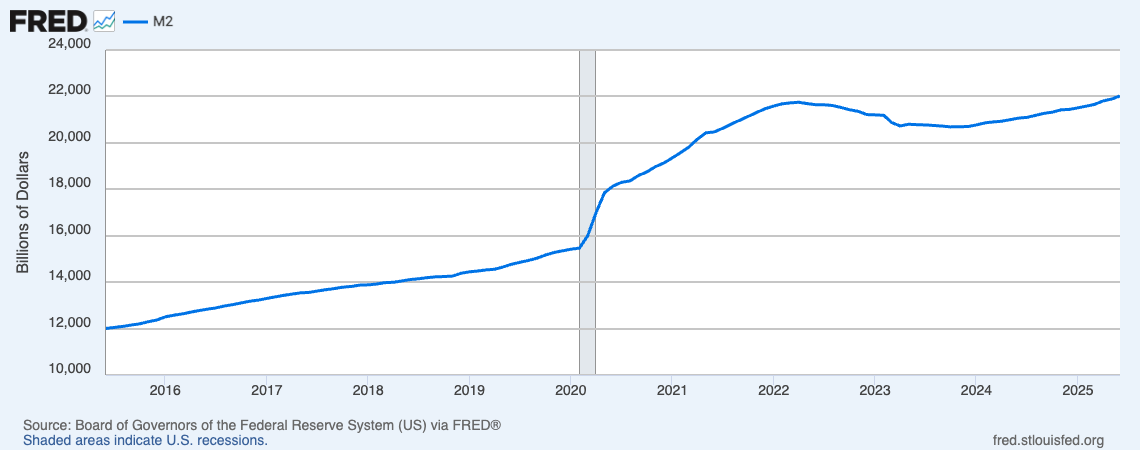
Meanwhile, global M2 liquidity is on the rise. Even if central banks have paused or slowed rate cuts, liquidity remains. We often forget that monetary policy isn’t the only form of liquidity. Commercial banks set financial conditions too, via lending standards, credit hurdles, and loan demand from mid-to-large corporates. This data is readily available to all retail on great websites like MacroMicro.com

It’s warm inside, let’s wait for Santa

We’ve entered a sweet spot in markets. Momentum is building, and signs point to a strong lead-in to year-end. So, the key goal posts will be NVIDIA on August 27 and US earnings in October as we leapfrog from one signpost to the next. 

Here’s what I’m watching: 

  • China’s Bloomberg Credit Impulse is on the rise – one of the best forward indicators 

  • US and China M2 growth is picking up. 

  • US PMI has slumped into contraction territory. This is odd at this point in the cycle 

  • US GDP languishing at sub 2% - these are the optimum temperatures for liquidity intervention by central banks. 

  • US Inflation? Nowhere in sight yet. 

  • PPI on the rise 

  • SPY implied volatility for calls is higher than puts. 

  • AI scepticism is fading, and we may be at the start of a commercial inflection point, particularly following the recent earnings period for the MAG-7. Like the efficiency drive set by the tech sector in late 2022 (the start of the present business cycle), this is the next wave of efficiency gains by this sector. 

  • Long/short strategies and stock picking are seeing renewed interest. 

  • FINRA margin balances appear ready to break out -  another indicator of increasing risk appetite and late cycle crazy. 

M2 Money Supply

All signs suggest the market is heating up now. The question now is whether we can link to the next leg up. If we reach the next US earnings in late October without a hitch, we can reach the so-called Santa Rally. This is less about magic and more about machine-driven seasonality around triple witching in December and year-end positioning. It's not voodoo; it’s more about math, momentum, and liquidity. 

Key signposts: 

  • NVIDIA Earnings – Wed 27 Aug 

  • US PPI – Wed 10 Sep 

  • US CPI – Thu 11 Sep  

  • Fed Meeting – Wed 17 Sep 

  • Sept Futures Expiry – Fri 19 Sep 

  • US Earnings – mid October -> late Oct 

  • Santa Rally to Dec Futures Expiry – Fri 19 Dec 2025 

Final Thoughts 

There’s no shame in changing your mind and caring less about being right. I’ve moved from rigid value investing to a more dynamic, responsive view of markets. This flexibility has never been more essential. 

What might been a normal business cycle may be extended now due to the April shock and the key player of central bank monetary influence yet to reignite. Markets may be front-running this. Lets see!  

Warm regards, 
Michael Bogoevski 
Head of Institutional, CMC Connect ANZ

Disclaimer: This article provides general information only. It has been prepared without taking account of your objectives, financial situation or needs. It is not to be construed as a solicitation or an offer to buy or sell any financial instruments, or as a recommendation and/or investment advice. It does not intend to support an investment decision and it should not be relied upon by you in evaluating the merits of investing in any financial instruments. You should consider your objectives, financial situation and needs before acting on the information in this article. CMC Markets believes that the information in this article is correct, and any opinions and conclusions are reasonably held or made on information available at the time of its compilation, but no representation or warranty is made as to the accuracy, reliability or completeness of any statements made in this article. CMC Markets is under no obligation to, and does not, update or keep current the information contained in this article. Neither CMC Markets nor any of its affiliates or subsidiaries accepts liability for loss or damage arising out of the use of all or any part of this article. Any opinions or conclusions set forth in this article are subject to change without notice and may differ or be contrary to the opinions or conclusions expressed by any other members of CMC Markets.