Joint US-Japan intervention supports the yen, but will it be enough?
A coordinated intervention by Japan and the US has strengthened the yen and pushed USD/JPY sharply lower. However, without a shift in the US-Japan interest-rate gap, the move may prove temporary and leave the yen carry trade as a continuing risk for global markets.

CMC Markets Poland
Joint intervention lifts the yen
Japan's Ministry of Finance and the US Treasury carried out a coordinated direct intervention in the currency market, aiming to support the yen and halt its sharp depreciation against the US dollar.
Following the move, which analysts estimate was worth more than $50bn, the Japanese currency strengthened by almost 5%. The yen recovered part of its losses from 40-year lows, with USD/JPY falling from around ¥164 to roughly ¥156.70 per dollar.
The Federal Reserve also joined the operation by selling euros and buying yen, a move that President Donald Trump described as a gesture of friendship towards Tokyo. The intervention also pushed the US Dollar Index below 100 for the first time in several months. Even so, currency-market experts described the initial reaction as relatively moderate compared with historic moves in the exchange rate.
USD/JPY daily chart, November 2025 – present
Source: CMC Markets, 5 August 2026
Intervention cannot solve the rate gap
Currency analysts warn that intervention without changes in central-bank policy is only a short-term bandage. The fundamental cause of yen weakness is not speculation, but the huge interest-rate gap between the US and Japan.
While interest rates in the US remain at 3.50–3.75%, the Bank of Japan keeps its main rate at just 1%. With inflation in Japan approaching 2%, that leaves real rates negative.
From Washington's perspective, prolonged Japanese intervention also carries risks. Tokyo usually finances purchases of its own currency by selling US Treasuries, which can push their yields higher in the bond market.
A lasting yen recovery needs a policy shift
Experts note that the yen is deeply undervalued and that Japan has the highest current-account surplus in the G7. Even so, a durable change in the currency trend is unlikely without decisive action from the Bank of Japan.
Unless the Japanese central bank starts a bolder rate-hiking cycle, or unless the Federal Reserve begins cutting rates aggressively, capital is likely to keep flowing out of Japan in search of higher returns.
Without a change in the interest-rate differential, direct currency-market intervention will remain an expensive attempt to hold back a much larger force.
Yen carry trade remains a global risk
In the fight over the yen, it is worth understanding the mechanism that has shaped global financial markets for more than two decades: the yen carry trade.
The idea is simple, but powerful. International funds and investors borrow Japanese yen at very low interest rates, for example 0.5–1%, then immediately convert those funds into dollars, euros or other currencies to invest in higher-yielding bonds or US technology stocks.
The investor's profit is the difference in interest rates, minus the cost of borrowing. The problem arises when the yen suddenly strengthens sharply. Investors using the carry trade panic because their yen debt becomes much more expensive to repay in dollar terms. That can force them to sell foreign equities and bonds quickly in order to buy yen and repay loans.
This sudden unwinding of carry-trade positions is often a quiet driver of declines on Wall Street and European equity markets, meaning Bank of Japan decisions can have a direct impact on portfolios around the world.
Europe and Wall Street extend gains
Optimism returned to European equity markets after a period of searching for direction, with investors again showing an appetite to climb towards all-time highs. The previous session across the main European exchanges ended in a positive mood, with leading indices gaining between 0.2% for the FTSE 100 and 1.26% for the FTSE MIB.
On Wall Street, buyers dominated for a third consecutive session. The Dow Jones gained 1.71%, the S&P 500 rose 1.79%, and the technology-heavy Nasdaq advanced 2.59%.
Asia sees more optimism
Asian markets have shown mixed sentiment over the past five weeks, and the current week has also failed to deliver a clear direction. However, today's session brought a better mood following gains on Wall Street.
Japan's Nikkei was up 3.4%, Australia's S&P/ASX 200 gained 0.75%, and South Korea's KOSPI rose 4%. Elsewhere in the region, Hong Kong was down 0.1%, Shanghai gained 1.3%, India's Sensex rose 0.3%, and Singapore declined 0.55%.
Warsaw continues to push higher
For the WIG20, the 4,000-point level is now within reach. The Warsaw market continues to climb towards record levels, extending the upward trend seen in July.
The June decline in the WIG20 was halted near local support around 3,553 points, where a solid demand response emerged. For now, fear remains hard to see, although uncertainty is appearing in European indices, the S&P 500 and the Nasdaq 100.
The global risk-asset backdrop remains dynamic and tense. The biggest short-term problem for markets, and for Wall Street in particular, may not be the prospect of higher interest rates, but rapidly shrinking financial liquidity. The US Treasury has reduced the scale of bond purchases by half, and alongside accelerating credit activity this is draining capital from the system.
Much will depend on the US bond market. A further rise in yields would increase concern about inflation and could ultimately lead to higher rates later in the year, raising the cost of corporate financing. For now, investors are still largely ignoring that uncertainty. However, Warsaw is not isolated from the rest of the world, and if scepticism returns to global markets, a correction should also be considered.
Turnover across the broad market reached PLN3.15bn. The WIG gained 2.06%, blue-chip stocks rose 1.35%, and WIG20 futures advanced 2.48%. Mid- and small-cap stocks also joined the move, with the mWIG40 up 1.68% and the sWIG80 ending 1.62% higher.
The zloty tries to recover
The zloty, which has recently been under pressure, is trying to recover lost ground.
GBP/PLN is currently trading around zł5.01, while EUR/PLN is quoted at zł4.29.
USD/PLN is trading around zł3.72, CHF/PLN stands at zł4.60, and PLN/JPY is quoted at ¥42.33.
USD/JPY tests July 2024 high as rate expectations diverge
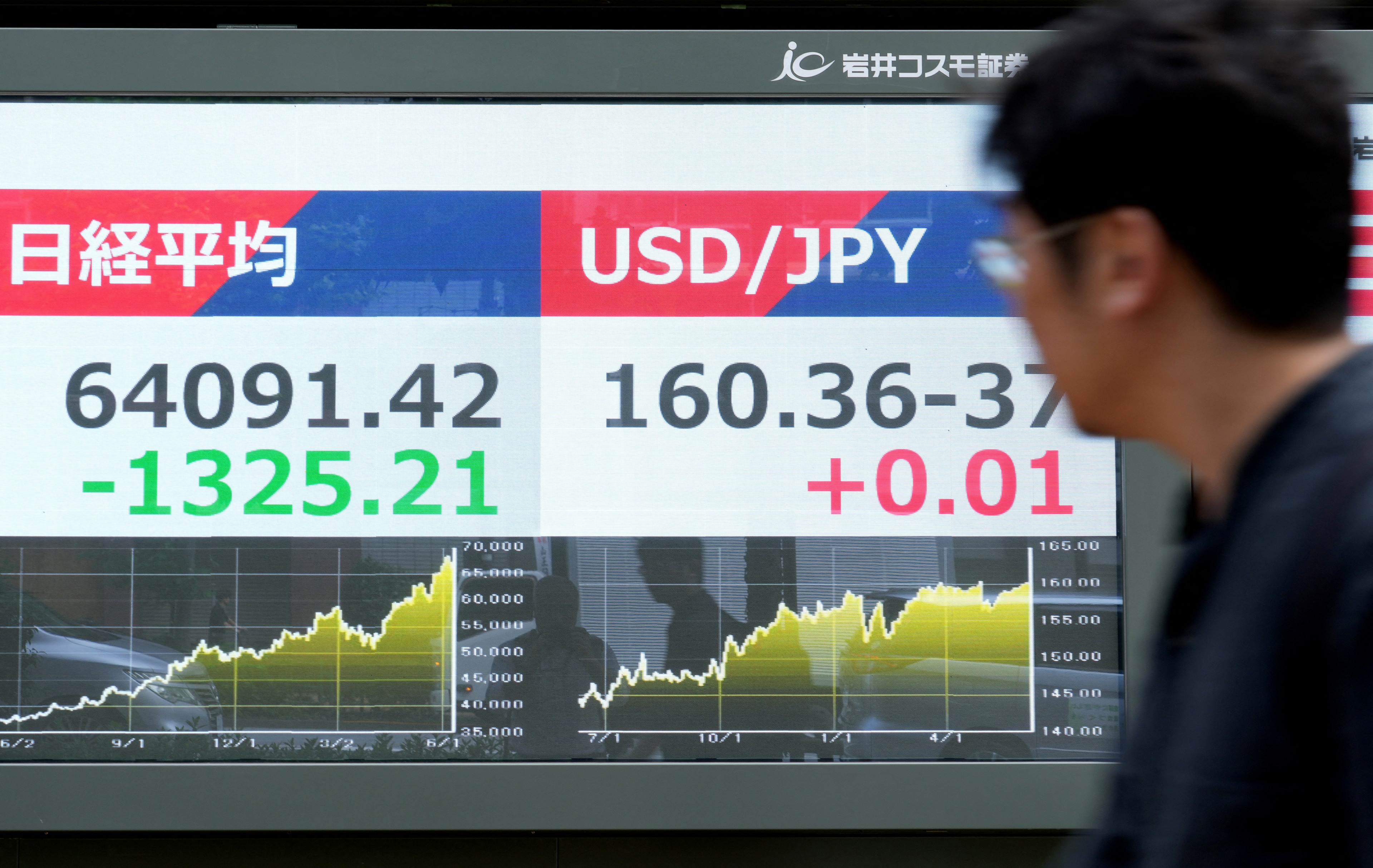
USD/JPY is approaching the July 2024 high near 161.75 as markets look past the latest Bank of Japan rate increase and continue to price wide US-Japan rate differentials. A break above that area could keep the dollar-yen uptrend intact, but the risk of renewed Japanese intervention remains the main counterweight.
The yen faces a defining week as the BoJ decision nears
The Bank of Japan's policy decision on 16 June could define the yen's next move, with markets pricing more than a 90% chance of a rate rise to 1% and USD/JPY already trading above 160. The chart still leaves room for more upside in the pair, but lower oil prices and any hawkish surprise from the BoJ could yet give the yen some support.

Yen weakness builds as USD/JPY nears key resistance
USD/JPY is pushing back towards 159.50, a level that acted as support and resistance before Japan's late-April intervention. If that barrier gives way, the pair could retest 160.50, while the Bank of Japan's delayed policy meeting and still-elevated oil prices continue to leave the yen exposed.